

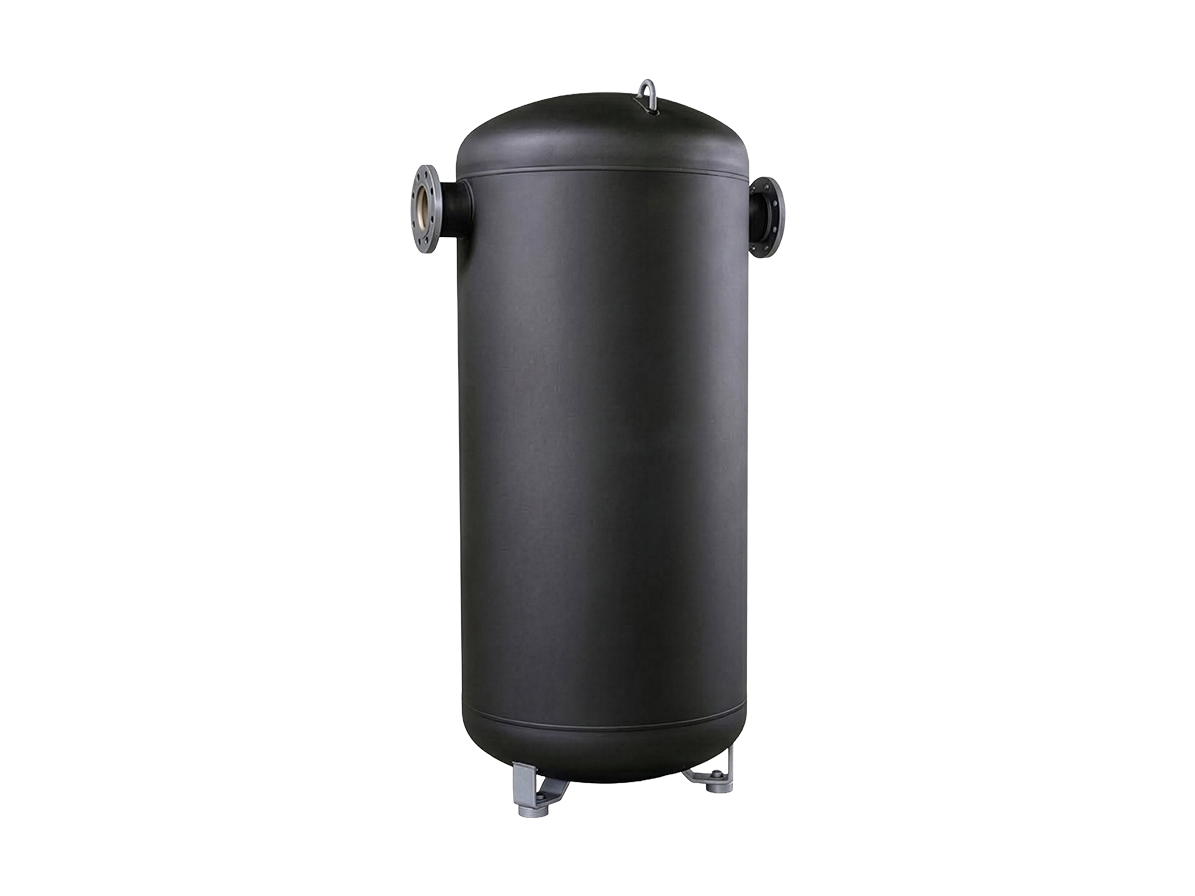
Data Center Buffer, Expansion, and TES Vessels: A Specification Guide
Data center cooling plants run on three vessel classes: buffer tanks that add thermal mass to the chilled-water loop, expansion tanks that manage volume change, and thermal energy storage tanks that shift or ride through load. All three are specified as ASME Section VIII, Div. 1 & 2 pressure equipment. TRIARC Tank, the largest tank manufacturer in the Americas, builds all three.
What Does Each Vessel Do in the Loop?
Different jobs, often confused on early drawings.
| Vessel | Job | Sizing driver | Typical notes |
| Buffer tank | Adds loop volume so chillers cycle sanely and controls stay stable | Gallons per ton against minimum system volume | Inline on the loop; baffling/connection layout matters |
| Expansion tank | Absorbs fluid volume change with temperature | System volume, temperature range, fill pressure | Sized small relative to buffer; pressure class must match loop |
| TES tank | Stores cooling capacity to shift load or bridge events | Ton-hours required, delta-T, stratification quality | Largest of the three; diffuser design decides performance |
AI-era load has raised the stakes on the first and third rows. High-density halls swing load fast, and a loop without enough thermal mass answers with short-cycling chillers and unstable supply temperatures. TES has moved from a utility-rate play to a resilience play: ton-hours in a tank is ride-through the generators don’t have to carry in the first minutes of an event.
How Is a Buffer Tank Sized?
Against minimum system volume. Chiller manufacturers publish a minimum loop volume per ton for stable operation, commonly in the range of a few gallons per ton for comfort duty and considerably more for process-critical loads with tight temperature tolerance. The mechanical engineer computes actual loop volume from piping and equipment; the buffer tank makes up the shortfall. On data center work, the shortfall is usually large, because compact plant layouts strip piping volume exactly where dense IT load needs more of it.
Two construction details earn their line on the spec. Connection placement and internal baffling should force flow through the vessel rather than letting it short-circuit port to port; a buffer that mixes poorly is a smaller buffer than its nameplate. And design pressure should match the loop with margin, typically in the 125 to 150 psig class on chilled-water work, stated plainly on the data sheet rather than inherited from a catalog default.
What Belongs on the TES Spec?
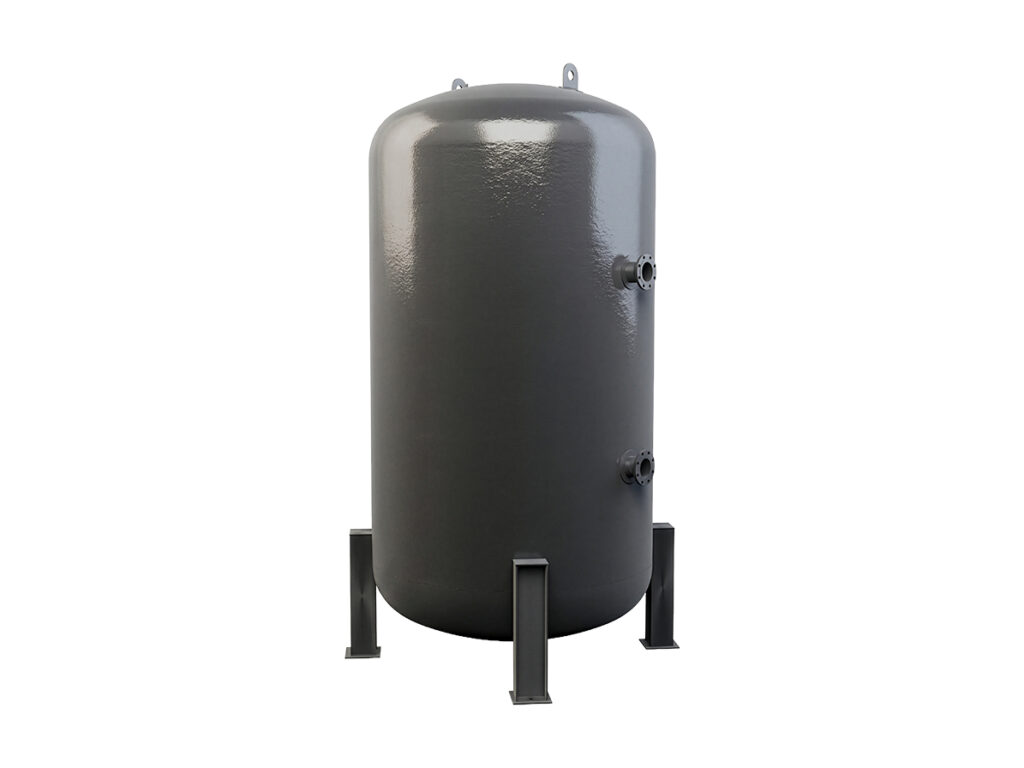
Ton-hours, delta-T, and stratification. A stratified TES tank holds cold supply and warm return in one vessel, separated by a thermocline whose quality decides how much of the stored volume is actually usable. Diffuser design at top and bottom sets that quality. Beyond the thermal spec: vessel volume and geometry against site footprint, design pressure and temperature, nozzle schedule for charge and discharge flow rates, instrumentation wells at multiple elevations so controls can see the thermocline, insulation scope, and the documentation package. Full material traceability and the Form U-1A come standard on TRIARC vessels, which is what commissioning agents mean when they ask whether the tank paperwork is real.
What Do Commissioning Teams Reject?
The same three findings, project after project. Vessels whose stated pressure class doesn’t match the loop’s relief settings. Buffer tanks piped so flow bypasses the volume. Documentation gaps that stall turnover while a nameplate question gets researched. All three are specification failures, not manufacturing failures, and all three are cheap to prevent at the data-sheet stage. Bring the loop schematic when you quote the vessel and the vessel will fit the loop.
How many gallons per ton does a buffer tank add? Enough to reach the chiller manufacturer’s minimum system volume; process-critical data center loops typically need several times comfort-duty volume. Compute the shortfall, don’t guess it. | Is a TES tank a pressure vessel? On pressurized chilled-water loops, yes, and it’s specified as ASME Section VIII, Div. 1 & 2 equipment with stratification internals. | Buffer and expansion in one tank? Different jobs, different design points. Combining them usually compromises both. |