

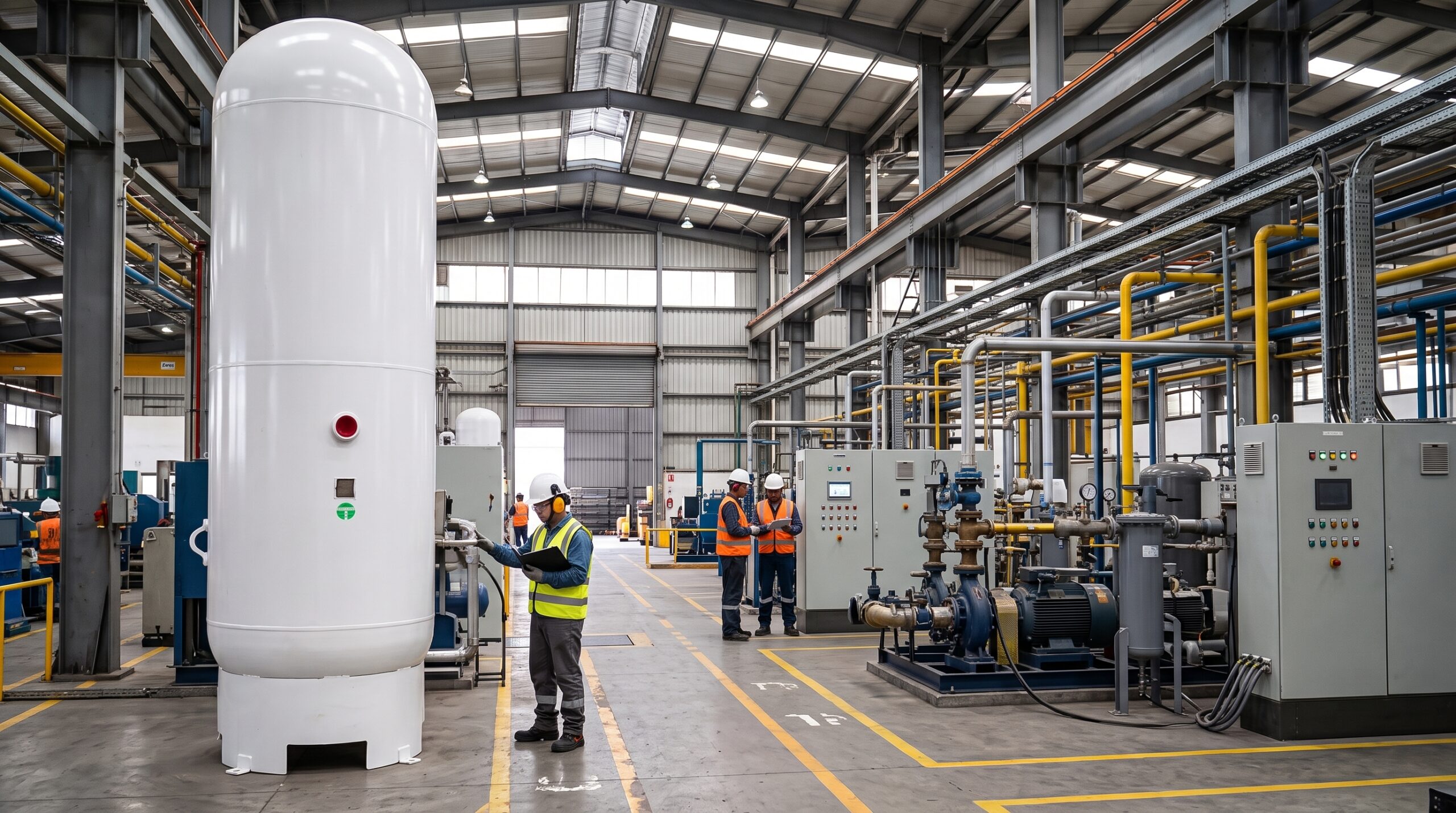
Air Receivers 101: ASME Sizing for Compressed-Air Systems
An air receiver is a pressure vessel, and in a U.S. workplace it has to be built to the ASME Code, OSHA 29 CFR 1910.169 says so outright. Size it from a 3–4 gallon-per-scfm baseline, verify against your largest intermittent demand with the receiver time formula, and register it with the National Board. TRIARC Tank, the largest tank manufacturer in the Americas, builds receivers to ASME Section VIII, Div. 1 & 2 in standard and custom configurations.
Does OSHA Really Require an ASME Receiver?
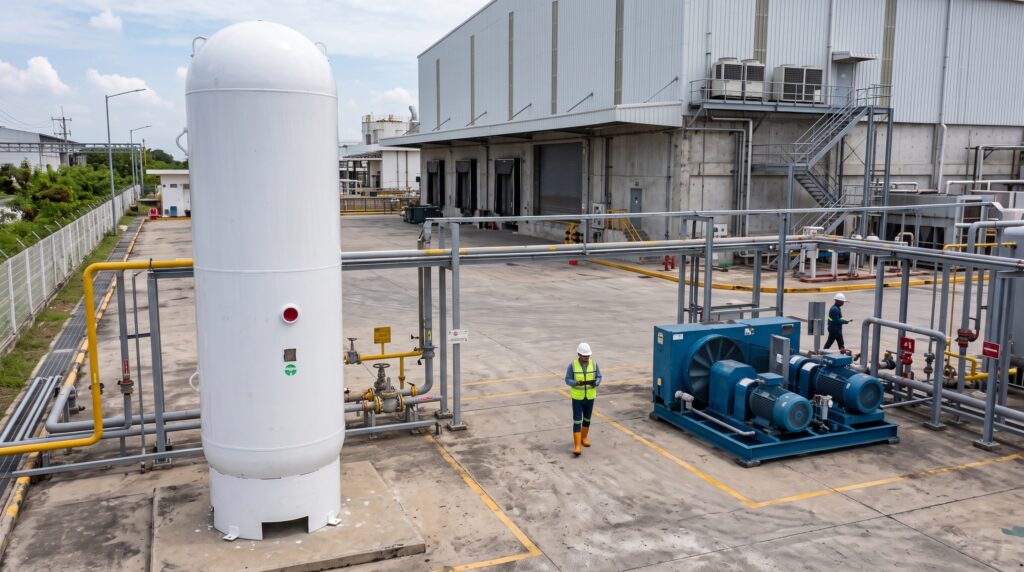
Yes. The regulation is 29 CFR 1910.169, and it’s specific: receivers constructed to the ASME Boiler and Pressure Vessel Code, an indicating pressure gauge, spring-loaded safety valves with enough combined relieving capacity to keep pressure within 10% of the vessel’s MAWP, and an accessible drain.
Which means the bargain non-code tank on a plant air system isn’t actually a bargain. It’s a citation that hasn’t happened yet, sitting on top of a stored-energy hazard. Check the nameplate for the ASME stamp and a National Board number before the tank gets any further consideration.
How Big Should the Receiver Be?
Start with the rule of thumb, then check it against your worst event. For general plant air, 3 to 4 gallons of receiver volume per scfm of compressor capacity is a sound baseline. One gallon per scfm is a bare minimum for steady loads, and high-cycling or variable-speed systems earn the larger figure.
Then verify with the receiver time formula:
t = V × (p1 − p2) / (C × pa)
where t is the minutes the receiver can carry the event, V is receiver volume in cubic feet, p1 is starting pressure (psig), p2 is the minimum acceptable pressure (psig), C is the event’s air demand (scfm), and pa is atmospheric pressure (14.7 psia). Work it backward from whatever defines your peak, the blast cabinet, the baghouse pulse, the big cylinder actuation, and the formula tells you how much volume rides through the event without dropping tools below their minimum.
| Receiver size | Typical service |
| 30–120 gal | Small shop compressors, point-of-use buffering |
| 240–660 gal | General plant air, 25–100 hp systems |
| 1,060–1,550 gal | Large plant air, surge control for heavy intermittent demand |
| Custom / multiple | Process air, redundancy, high-cycling loads |
Wet Receiver or Dry Receiver, and Where Does Each Go?
In many well-designed systems, the answer is both. A wet receiver sits between the compressor and the dryer, where it knocks out bulk moisture, cools the air, and smooths pulsations so the dryer sees steady flow. A dry receiver sits after the dryer and stores clean air for demand events, so the dryer doesn’t have to be oversized just to handle peaks. A common split runs about a third of total storage wet and two thirds dry.
Wherever a receiver sits, it needs a drain that actually gets used, automatic, or manual on a schedule somebody owns. Condensate standing in the bottom is the classic way these simple vessels rust from the inside, and it’s also the reason a stated corrosion allowance belongs on the purchase spec instead of in the buyer’s assumptions.
What Should the Purchase Spec Say?
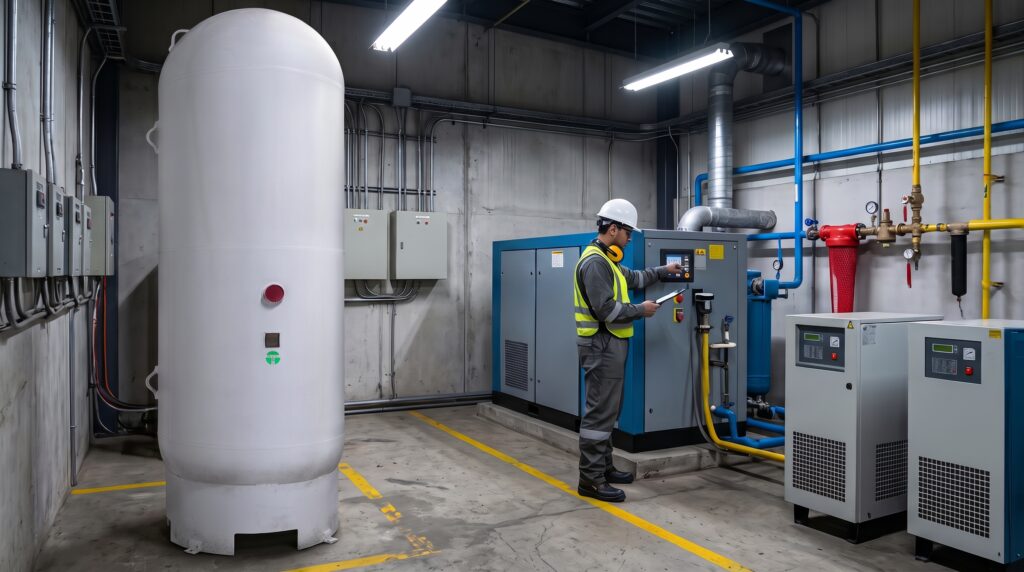
At minimum: ASME Section VIII, Div. 1 & 2 construction with the division stated; MAWP, where 200 psig is the common industrial standard and higher gets specified when the system demands it; orientation, since vertical saves floor space and drains better; capacity in gallons; a nozzle schedule covering inlet, outlet, drain, gauge, and relief; corrosion allowance; interior and exterior coating; and National Board registration named as a deliverable alongside the Form U-1A and material traceability records. TRIARC supplies all of that as standard, which turns the receiver from a procurement project into a line item.
Does OSHA require ASME-code air receivers? Yes. 29 CFR 1910.169 requires ASME construction plus a gauge, adequate relief capacity, and a drain. States may add installation and inspection rules of their own.
How many gallons per CFM do I need? 3–4 gallons per scfm of compressor capacity as a baseline, then verify with the receiver time formula against your largest intermittent demand.
Wet receiver or dry receiver? Wet before the dryer protects and steadies it. Dry after the dryer stores clean air for peaks. Plenty of plants run both.
What routine maintenance do receivers need? Drain condensate daily or automatically, service relief valves on schedule, and inspect per your jurisdiction’s rules. Receivers are simple equipment, but only while they’re dry inside.
A receiver sized to your real demand profile, not a catalog guess: call 888-558-8529 or start at triarctank.com.