

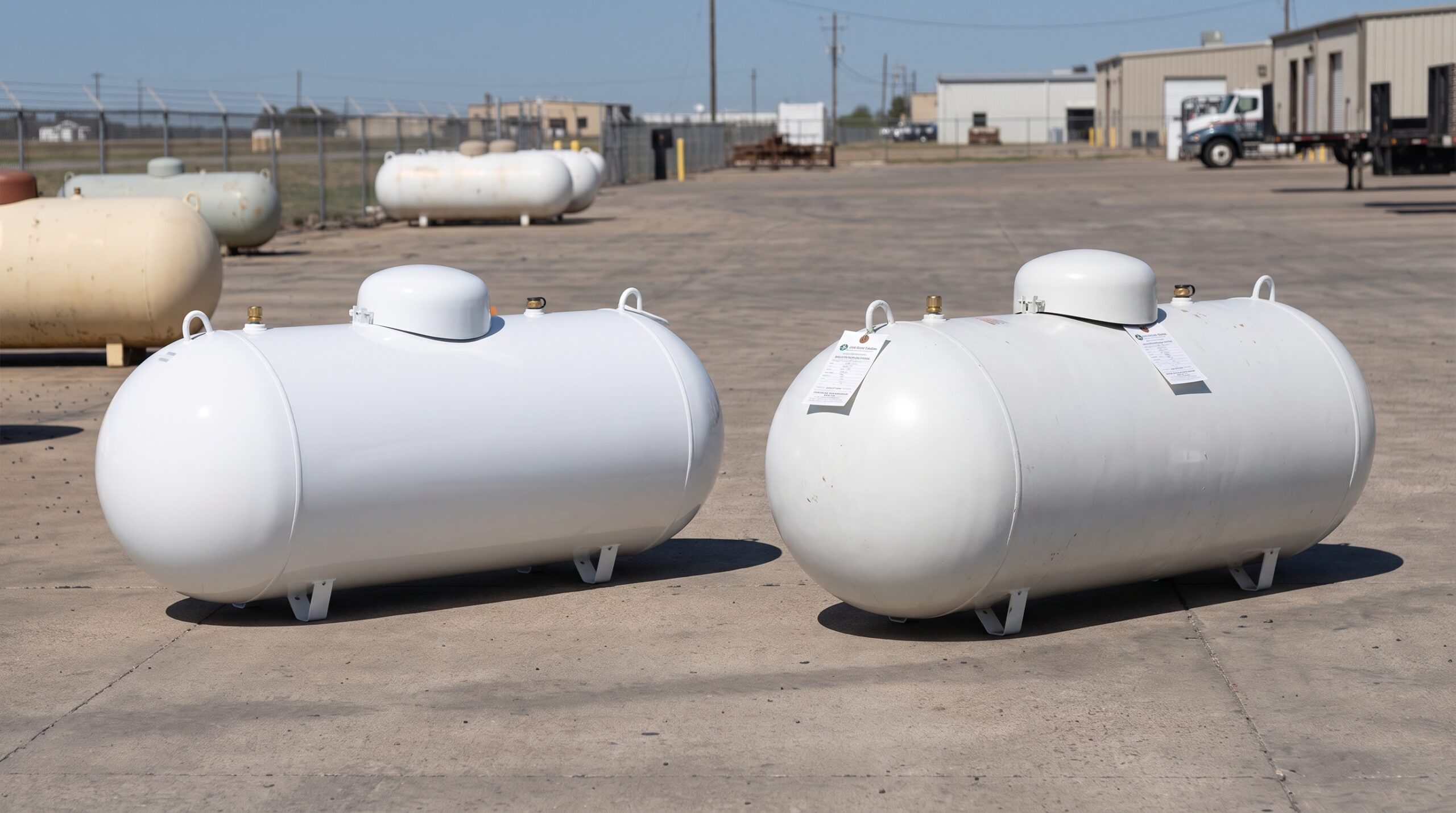
When Refurbishment Makes Sense and When It Doesn’t
Factory-refurbished tanks fit short-horizon service, infill singles, rental pools, and capital-tight growth years. New tanks win standardized set programs, long-life account assets, and territories that eat coatings. Four factors make the call, not sticker price. TRIARC Tank, the largest tank manufacturer in the Americas, sells both sides of that mix and quotes them in one order, so our interest is in you getting the split right, not in steering every unit one direction.
What Four Factors Drive the Call?
Size, service horizon, territory, and volume, and it’s worth saying why each one earns its place.
Size matters because reconditioning costs nearly the same regardless of tank size. A 120-gallon tank’s valve train costs about what a 1,000-gallon tank’s does, so the math weighs heaviest against the smallest, cheapest units. Service horizon is the big one: a tank set on a customer account is a twenty-year decision, while a rental unit on construction heat is a twenty-month one, and those two jobs don’t need the same asset. Territory matters because the environment sets the corrosion clock. And volume matters because a 400-tank set program lives on standardization and nested freight in a way a handful of infill units never will.
How Does the Framework Read by Scenario?
| Scenario | Size class | Horizon | Lean | Why |
| Core set program, growth territory | 250–1,000 gal | 20+ yr | New | Standardization, freight density, full life per dollar |
| Infill singles, established routes | Any | Varies | Factory-refurbished | Freight density never comes; verified singles fill gaps cheap |
| Rental / temporary heat, ag drying | 100–1,000 gal | 1–5 yr | Factory-refurbished | Asset outlives the job either way; verified units cut callbacks |
| Coastal or road-salt territory | Any | Any | New | Fresh corrosion margin and factory coating earn their cost |
| Capital-tight expansion year | 250–500 gal | Long | Mixed | Refurbished gains accounts now; convert to new as capital allows |
| Bulk plant / large ASME vessels | 6,000 gal + | 30+ yr | New, case-by-case exceptions | Inspection stakes rise with size; refurbished only with full intake records |
| NH3 and specialty service | Any | Any | New | Service severity and compliance exposure narrow the used market |
These are leans, not laws. Documented intake readings can move a row, and a state inspector with strong opinions can move it right back. The two rows that shouldn’t move are the corrosion territories and the specialty services, because the downside there isn’t resale value. It’s exposure.
What Does Territory Do to the Answer?
Territory sets the corrosion clock. A tank that runs for decades in a dry inland county ages faster at the coast, where salt air works every flaw in a coating, and faster still on routes where winter road treatment mists the lower shell for months at a stretch.
This is also where “refurbished” and “factory-refurbished” stop being the same word. An open-market unit arrives with its corrosion margin partly spent and its recoat quality unknown at the pit level. A factory unit arrives with thickness readings on record and a coating applied to spec. Even so, in genuinely hard territory we’ll quote you new, because that’s what we’d set there ourselves.
How Do You Set Policy Instead of Re-Deciding Every Lot?
Put the four factors on one page and make it the standard: which programs are allowed to take factory-refurbished units, the published intake checklist as a hard requirement for anything bought outside our program, the per-year cost test as the tiebreaker, and a short list of walk-away triggers that no discount gets to override. After that, buying stops being a debate and becomes execution.
Send us the standard once it’s written and we’ll quote your season against it, new for the core program, factory-refurbished for the rental pool and infill, one order, specific delivery weeks on both.
FAQ
What’s the fastest rule of thumb? Match the asset’s life to the job’s horizon. Long-horizon accounts get new, short-horizon service gets factory-refurbished, and hard-corrosion territory gets new regardless.
Do small tanks refurbish economically? They’re the worst class of any as a do-it-yourself project which is exactly why factory-scale refurbishment, where the work is batched, is where small-tank refurbs make sense at all.
Is a mixed policy defensible? It’s the norm at well-run marketers, and it’s how we quote: new for the core, refurbished for infill and rentals, reviewed once a year.
Will TRIARC steer me to one or the other? To whichever the framework says. We sell both, so the framework can afford to be honest.
Mixed new and factory-refurbished quotes against your inventory policy: call 888-558-8225 or start at triarctank.com.