

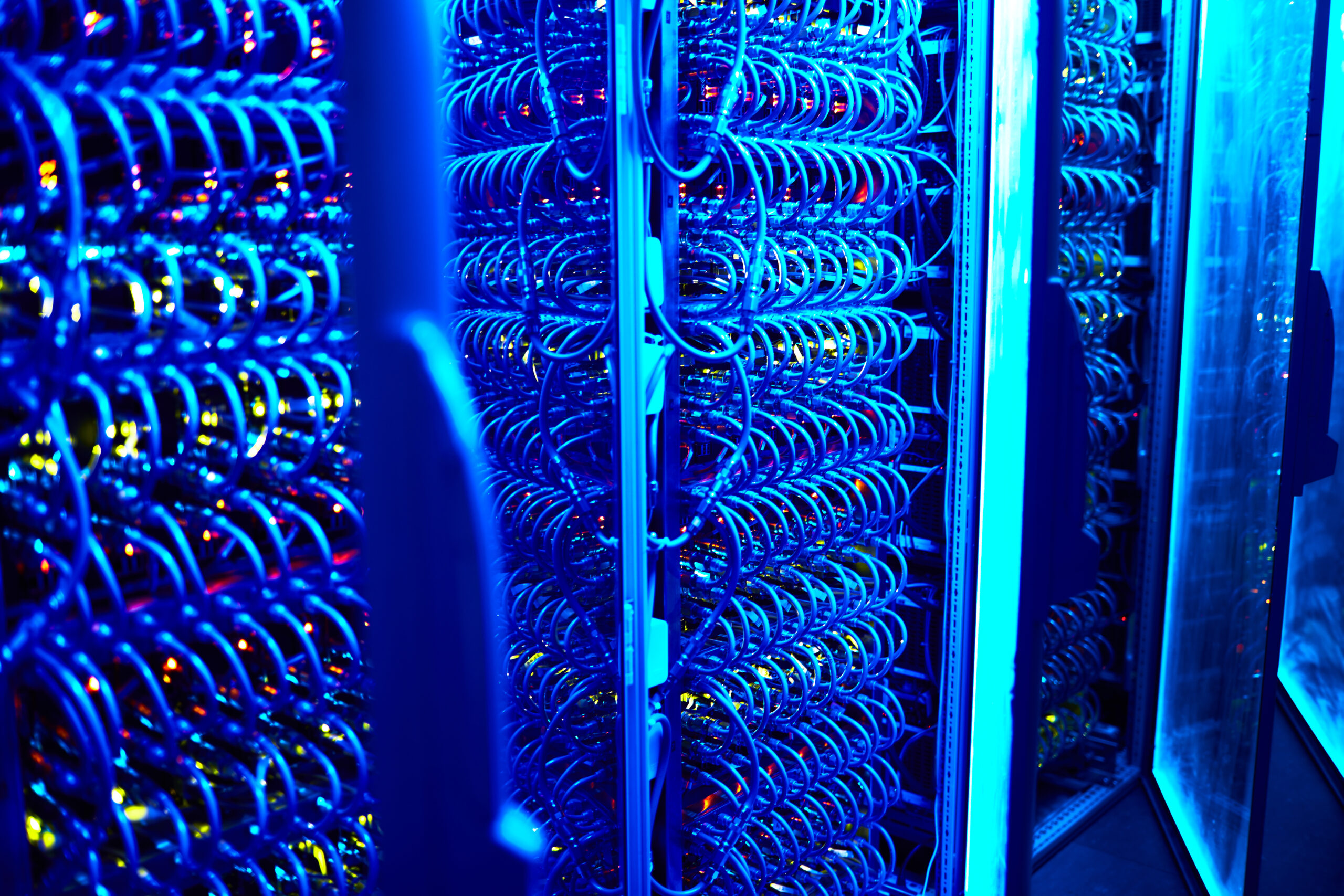
TRIARC and the Data Center Boom: Supplying the Tanks That Keep AI Cool
TRIARC & Data Centers
Built for a market that never stops growing
For over 90 years, TRIARC has engineered pressure vessels and storage tanks for the most demanding industrial applications in North America. Today, one of the fastest-growing markets we serve is data center cooling infrastructure (and the scale of that demand is unlike anything the industry has seen before).
As hyperscale campuses multiply and AI workloads push rack densities to new extremes, the hydronic cooling systems behind those facilities require thermal storage, flow stability, and pressure management at a level that standard off-the-shelf equipment simply cannot deliver. That is exactly where TRIARC’s custom manufacturing capability (ASME-certified, built to spec, and backed by decades of pressure-vessel expertise) steps in.
The Data Center Market
A sector redefining what infrastructure means
U.S. data centers used 176 TWh of electricity in 2023 (4.4% of all national electricity consumption) and Berkeley Lab projects that figure could reach 325–580 TWh by 2028. The IEA separately projects a 130% increase in U.S. data center electricity demand by 2030, with global data center electricity growing at roughly 15% per year through the end of the decade.
| 176 TWh | 580 TWh | 1,360 |
| U.S. data center electricity use, 2023 | Projected U.S. demand by 2028 (high case) | Hyperscale data centers worldwide, end of 2025 |
The physical buildout is equally striking. Synergy Research Group counted 1,360 hyperscale data centers worldwide at the end of 2025 (580 of them in the U.S.) and expects hyperscale operators to control 67% of global data center capacity by 2031, up from 48% today. Hyperscale capacity has already grown more than fourfold since 2018 and could double again in just over twelve quarters.
At the rack level, design assumptions are being rewritten in real time. Schneider Electric reports that next-generation AI clusters regularly exceed 100 kW per rack, with reference architectures supporting liquid-cooled deployments up to 132 kW per rack. NVIDIA’s GB200 NVL72 is itself a rack-scale liquid-cooled system. Power and cooling are no longer background decisions (they are strategic constraints that determine whether a campus can be built at all).
“Cooling infrastructure has to scale as intelligently as compute, and the window to get that infrastructure right is narrowing fast”.
Tanks in a Data Center
What tanks actually do inside a cooling plant
Modern data center cooling relies on hydronic architecture: chilled water circulates through a closed loop, air handlers and CRAHs pull heat from the room or directly from equipment, and a central chilled-water plant keeps the loop cold. In that system, tanks are not passive vessels, they are active components that determine how efficiently, reliably, and safely the whole plant operates.
TES Tanks
Thermal Energy Storage tanks decouple chiller operation from instantaneous load. They store cooling capacity during off-peak hours and release it when demand spikes, flattening electricity demand, reducing peak loads, and providing backup cooling for critical facilities.
Buffer Tanks
Buffer tanks add system fluid volume to prevent chiller short cycling in zoned chilled-water systems. Without sufficient buffer volume, chillers start and stop too frequently, hurting efficiency, increasing wear, and making precise temperature control harder in high-availability environments.
Expansion Tanks
Expansion tanks control pressure, absorb thermal expansion, and protect closed hydronic loops from excessive pressure events as fluid temperatures and volumes shift across operating modes. They are the mechanical protection layer that prevents thermal changes from becoming reliability problems.
Together, these three tank functions cover the full operational logic of a chilled-water cooling plant: store capacity, stabilize flow, and protect pressure integrity. For operators navigating volatile energy tariffs, constrained grid interconnections, or aggressive uptime SLAs, getting all three right is not optional, it is foundational.
Why TRIARC?
Your best partner for TES, expansion, and buffer tanks
1933
90+ years of pressure-vessel manufacturing
TRIARC has built ASME-certified steel pressure vessels and tanks since 1933. That depth of experience means we understand not just how to fabricate a vessel, but how to engineer one for the specific thermal fluids, pressure ratings, temperature ranges, and storage durations your cooling plant demands.
For data center customers specifically, TRIARC’s capabilities translate into a direct manufacturing advantage:
- Custom TES Tanks Engineered for your chilled-water architecture, sized to your load profile, and built to ASME Section VIII (up to 150,000 gallons).
- Buffer Tanks Custom fluid volume solutions designed to stabilize chiller operation, prevent short cycling, and support zoned chilled water systems at any scale.
- Expansion Tanks Pressure-management vessels built to maintain safe loop pressurization and absorb thermal expansion in closed hydronic systems.
- Large-Scale LPG Storage Backup-power fuel storage for hyperscale campuses (including vessels up to 90,000 gallons for on-site generator supply).
- Ammonia Storage Tanks Ammonia chiller systems or emerging green ammonia energy storage.
TRIARC’s compliance credentials support mission-critical procurement at scale: ASME Section VIII certification, European Pressure Equipment Directive acceptance, and board registration for worldwide deployment. In-house PWHT ovens, metallurgical labs, and certified NDT personnel mean quality is verified at every stage of fabrication, not assumed.
For data center owners, developers, and engineers, the bottom line is simple: a custom tank package aligned to your site’s load profile, chilled-water architecture, and uptime requirements is increasingly part of core plant strategy. TRIARC has been building those vessels for nine decades. We are ready to build yours.
Talk to the engineering team
Whether you’re planning a new hyperscale campus, densifying an existing facility, or engineering for resilience, TRIARC’s team can help size a custom TES, buffer tank, or expansion tank solution matched to your cooling plant and uptime goals.